

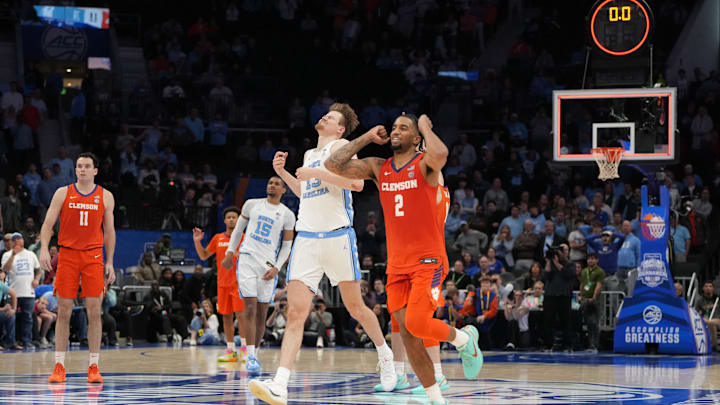
The UNC basketball program fell short in a feverish comeback attempt against Clemson in the ACC Tournament. The Tar Heels, fresh off a painful loss to Duke and the more painful loss of Caleb Wilson for the rest of the season (and his North Carolina career), built another double-digit deficit this season and fell just short in their attempt to get a third match-up with Duke.
Now, the focus turns to the NCAA Tournament. Hubert Davis and his squad will sweat as they wait to see how far their seeding will fall after losing their last two games and losing their All-ACC freshman phenom. It didn't have to be this way. Common shortcomings reared their ugly head again. If the Tar Heels don't learn from this, they'll have another early exit from March Madness.
Falling Behind
North Carolina has had a nasty habit of falling behind by double-digits throughout the season. Some of these setbacks have led to thrilling comebacks. Kansas, at Virginia, this:
What a way to win a game in the best rivalry in college basketball.
— Zach Schumaker (@ZachSchumaker) February 8, 2026
Seth Trimble has solidified his name in the Duke vs UNC rivalry.
pic.twitter.com/BoIv1w7mXX
Going behind this often is not good for business, though. In a single-game elimination sport, these deep holes leave too much to chance if your team isn't on it from the jump. North Carolina has made a nasty habit of falling behind too far, too often.
Credit should be given to Hubert Davis and the team for not giving up and continuing to fight, even when the task at hand seemed hopeless. It would be rational to withdraw when you're still down 15 with 3:33 left in the game. The common refrain when attempting a comeback is to be down 10 with 10:00 left, and down five with 5:00 left. This was much, much worse.
But Derek Dixon locked in, scoring a nifty lay-up and three three-pointers (granted, one was a banked prayer, and the other was ultimately to shrink the losing margin). Henri Veesaar scored eight of his 28 points--a season high! But ultimately, it all fell short in tragic circumstances.
Dixon and Jarin Stevenson running into each other with 28 seconds left and UNC trying desperately to close a five-point deficit is a kind of perverse analogy for much of the season, and certainly this game; good intentions ultimately met with failure. North Carolina will need to play focused from minute one in their first-round game in the NCAA Tournament.
Free Throws
I've harped on North Carolina's free-throw woes four times in conference play. It's a bugaboo destined to derail any positivity from the season, and it has reared its ugly head once again.
UNC was 10/17 from the line, under 60% again. And the Tar Heels lost by one point. If they could just get to 75%, they'd win the game! The misses were evenly spread amongst the team, but special consideration has to be given to Jonathan Powell, whose season free-throw average of 46.4% is barely higher than his three-point average, a perfectly respectable 38.4%. He went 0/2. Seth Trimble, whose free-throw average climbed for three seasons, culminating in a glistening 82.1%, crashed back down to earth to 67.2%. He was 1/3.
You can bet your bottom dollar that UNC will be in close games again this tournament. They have got to start hitting their free throws.
Iron Five?
North Carolina's bench was never fantastic, but when Caleb Wilson anchored the front court with Henri Veesaar and Kyan Evans starting, there was more firepower coming off the bench with Luka Bogavac and Derek Dixon.
Dixon's star has risen as he's taken over the starting point guard duties, but Evans has completely crashed out of orbit. He has largely been a non-factor since his demotion, and if we're perfectly honest (he is a paid student-athlete after all), the lights may be a bit too bright for him at Carolina.
And after a torrid patch after Wilson went down, Zayden High has calmed down a bit, perhaps now that he's got film out. Perhaps because he performed best against lesser teams, and is overmatched by better ones.
All of this brings up concerns for Hubert Davis and how he manages substitutes. He lacks game-changers, and if Jonathan Powell isn't hitting threes, there's no scoring punch from the bench. Perhaps he'll fall back into a familiar playbook from his first season.
When you look at the +/- stats from the one-point loss to Clemson, his starters were +3, +4, +7, +8, and +6. That's pretty good. Unfortunately, his bench players were diabolical. Four substitutes played, and they were a combined -33.
As long as the starters avoid foul trouble and fatigue (difficult with two games in three days), Coach Davis may be most comfortable playing his starters until the breaking point. After all, it's literally worse putting the bench in right now.
 Add us as a preferred source on Google