

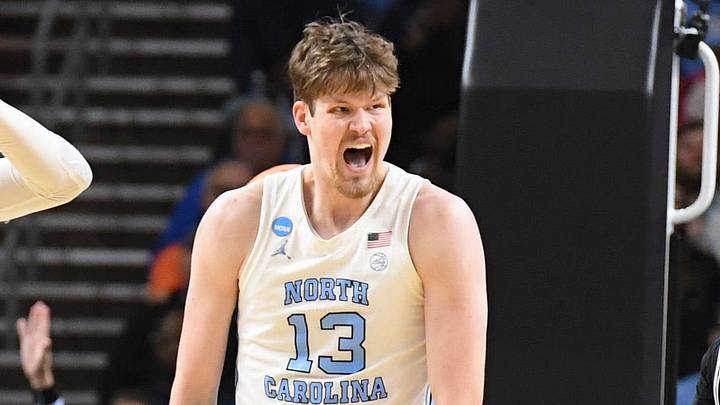
Henri Veesaar was reportedly set to cash in on at least a $4.5 million deal had he stayed at North Carolina for his final season of eligibility. However, Veesaar made it clear he was leaving Chapel Hill long before the deadline for others, like UNC’s Matt Able, to withdraw from the NBA Draft.
If Veesaar worked his way into the first round, with a guaranteed contract and a multi-million-dollar deal slotted for even pick No. 30, that would have proven to be the right call. Instead, he slipped out of Round 1 and was forced to wait until pick No. 52 when he was selected by the Atlanta Hawks.
Rather than having designated rookie scale contracts as first-rounders do, Veesaar will now have to negotiate a deal with Atlanta, with little chance of it being guaranteed beyond a year or two. Still, even facing what seems to be an uphill climb to make back that about $3 million difference he left on the table by leaving, he can turn what appears to be a disastrous mistake into an irrelevant footnote.
All that matters for Henri Veesaar is becoming a viable NBA player
Sure, the first round carries more guarantees, but teams do have the option to opt out of the four-year deal after Year 2 and Year 3, so there’s no certainty that he would have seen all $15 or so million designated for the 30th overall selection. Either way, Veesaar simply has to prove that he belongs in the NBA, and if he does that, nothing else will matter.
The 2025-26 NBA salary cap was set at $154.67 million, and the cap is projected to be set at $165 million in 2026-27. However, much like the revenue-sharing cap in college sports, it’s a soft cap. Teams can exceed it to pay their own players, and last season, all but one team in the NBA (the Brooklyn Nets) exceeded $154.67 million in payroll. That’s for a roster of 15 players. The Golden State Warriors paid a whopping $234 million for their roster.
There is plenty of money to go around among the roughly 450 players in the NBA, and if you prove to be a valuable asset in the league, you’ll cash in. Veesaar may not be the highest-upside prospect in the class. At 22 years old, league evaluators may believe he’s already made his biggest developmental jump, going from averaging 9.4 points and 5.0 rebounds at Arizona as a redshirt sophomore to scoring 17 points with 8.7 boards last season at UNC.
Veesaar isn’t a supreme athlete and won’t play above the rim, but as a pick-and-pop floor-spacing center with decent rim protection ability and a fair level of comfort in drop-coverage, he could be a rotational big as soon as this season. There aren’t many seven-footers shooting over 42 percent on 3.0 threes a game, and the ones who can do it in the NBA tend to get rewarded.
Sure, a bird in the hand is better than two in the bush, but the real way for Veesaar to maximize his earning potential is to become a serviceable NBA center. Whether that journey began this year or next, or as a first or second-rounder, is only relevant if he doesn’t have a long NBA career. He’s clearly betting that he will, and now he has a chance with the Hawks.
 Add us as a preferred source on Google