

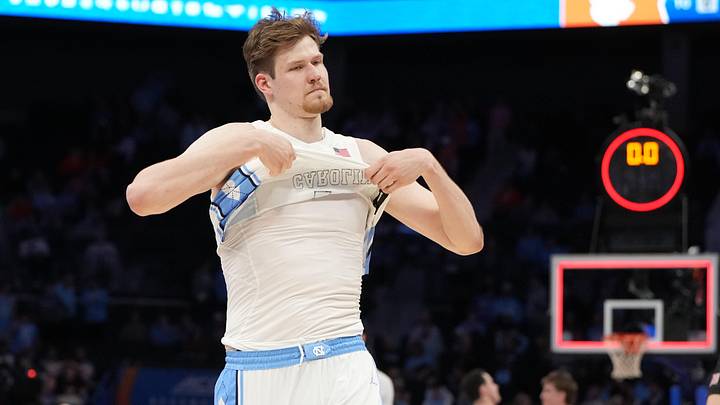
Editor's note: The story previous stated that Veesaar would have two years of elgibility through the NCAA's new five-in-five rule. However, Veesaar redshirted his first year at Arizona, so he would not get a fifth year back.
Henri Veesaar was never a lock for the first round of the NBA Draft, yet fairly early in the process, he made it clear that he wasn’t coming back to North Carolina. That decision proved costly, at least financially, when Veesaar slid out of Round 1.
Now, as the former UNC and Arizona center waits to hear his name called on Night 2 of the 2026 NBA Draft, he has to mull over the loss of a lucrative one-year deal to stay in college and face the uncertainty of negotiations as a second-round pick in the NBA.
Henri Veesaar left a major payday on the table by leaving UNC
CBS’s Matt Norlander reported that North Carolina and new head coach Michael Malone would have paid about $4.5 million to get Veesaar back in Chapel Hill for the 2026-27 season. That’s a big number to leave on the table for the uncertainty of the draft, even if Veesaar, who is engaged to be married, was rumored to simply be ready to move on from college and begin a professional career.
Even Koa Peat, who became the final pick of the first round at No. 30 overall on Tuesday night, will receive a four-year contract worth $15.5 million with a salary just over $3 million in Year 1. As a second-round pick, even if he’s selected at No. 31 overall, Veesaar's will not necessarily be fully guaranteed. Second-round picks do not have a rookie scale, as the first-round picks do, and often sign for the rookie minimum of just over $1 million for the first year.
Hope it works out for them, but tonight is a tough look for the stay-or-go decisions from UNC’s Henri Veesaar, Duke’s Isaiah Evans and Arkansas’ Meleek Thomas.
— Isaac Trotter (@Isaac__Trotter) June 24, 2026
Left serious money on the table in college. Fair to say they all may have miscalculated their market.
Those second-round contracts are negotiated individually, so Veesaar could be valued higher than that by the team that selects him, but there’s almost no world where he’s making $4.5 million, a number he could have cashed in for at UNC (or another college, for that matter).
Maybe Veesaar was just dead-set on leaving college. I know I was ready to get out when my four years were up, and I sure didn’t have a million-dollar salary waiting for me on the other side. But I also didn’t have a multi-million dollar salary there, for me, if I came back.
Henri Veesaar’s decision may have hurt UNC even worse
You have to feel for the player who made a significant jump during his lone season in Chapel Hill, going from a seven-footer who never had a double-digit rebound game through two years at Arizona to the prototypical stretch five and a double-double machine, averaging 17 points and almost nine boards.
Floor spacing and rim protection are a rare combo, and when you find them together, that’s a valuable player. Even on a team where freshman Caleb Wilson was universally acclaimed as the best player, Veesaar’s on/off splits dwarfed Wilson’s. Yet, as a below-the-rim athlete with a slight frame at 227 pounds, his value is a lot greater in the college game than in the NBA.
Malone could have built around Veesaar. With the Terrence Brown pickup, a slashing guard who would pair beautifully with a pick-and-pop five, he seemingly began to. Instead, he was forced to hop overseas to take swings on international bigs Sayon Keita and Alexandros Samodurov, who would both be wonderful complements to Veesaar in the front court, but carry significant question marks as first-year starters.
So, while Veesaar failed to maximize his earning potential, if he’s a good player in the NBA, he’ll make it back. UNC, however, will have a much tougher time replacing his production next year, and that could hold the Tar Heels back from contending for the ACC title with Duke and Louisville.
 Add us as a preferred source on Google